



Baffled Water Tank Anatomy
Understand the key components, fittings and features of a baffled water tank.
A baffled tank is designed with internal baffles to help reduce water movement when the tank is being transported or moved. But what are the different parts and what do they do?
In this guide, we’ll explain the main components of a baffled water tank and the common fittings you may encounter.
What is a Baffled Water Tank?
A baffled water tank contains internal walls that significantly reduce the movement of water when a tank is being transported. This helps to improve vehicle manoeuvrability and handling as well as reducing wear and tear on the vehicle.
Baffled water tank are most commonly used in applications where transporting water needs to be transported. Tanks are fitted to the vehicle, trailer or mobile equipment.
Baffled tanks are available in a range of sizes. Our range starts from 160 Litres upwards.
How is a tank baffled?
There are a number of ways in which a water tank can be baffled.
Internal structure
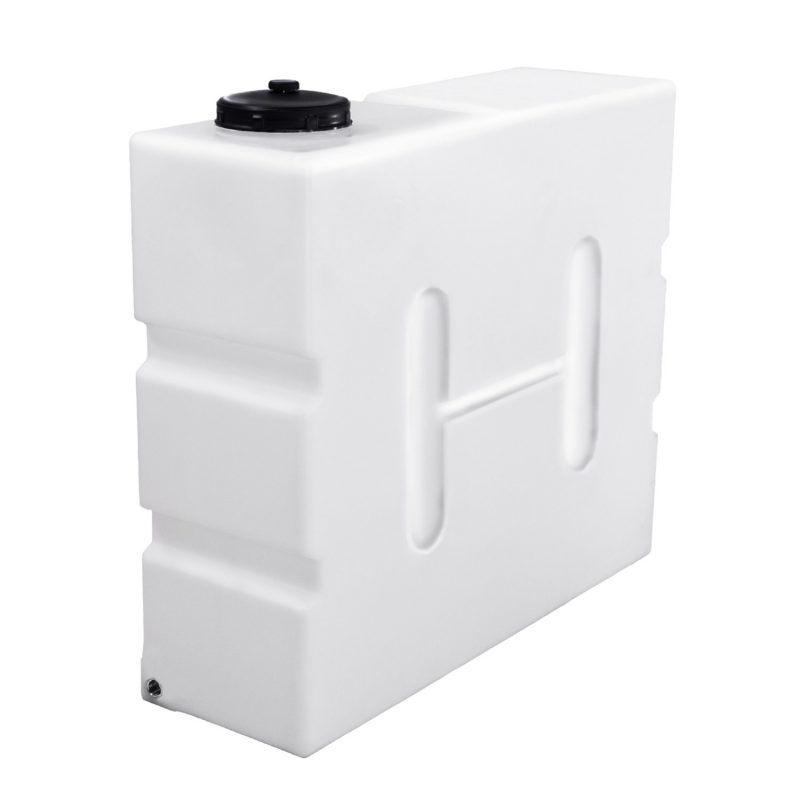
Most commonly, the baffles are designed into the tooling as part of the moulding process which ensures a strong, one-piece mould. You will see the internal structures of the wall when you open up the inspection cap. It will also be obvious from the outside as often, the baffles are designed as cut outs.
Baffle balls
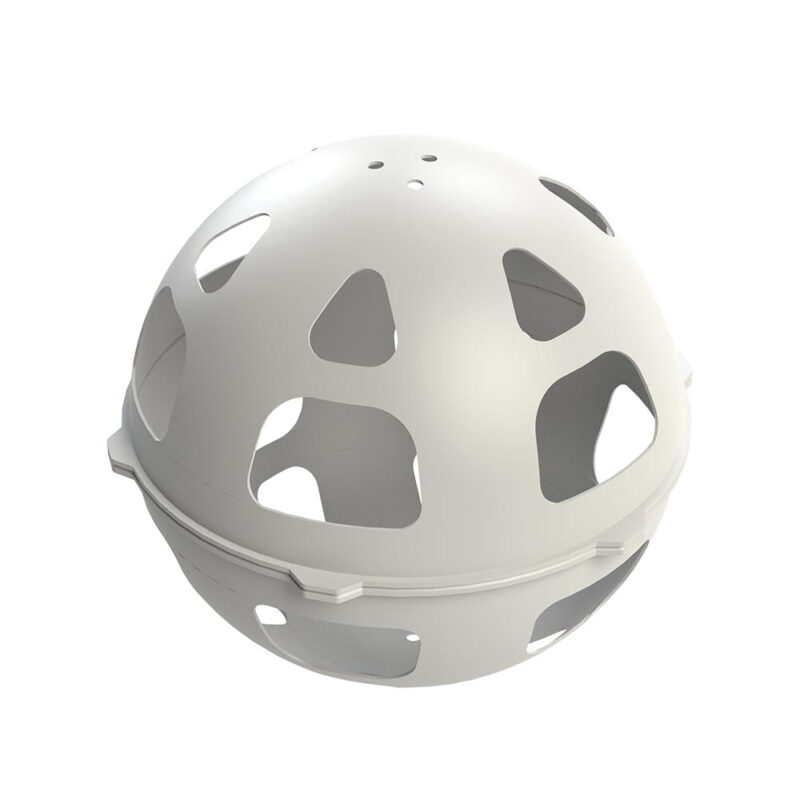
Baffle balls can be added to a plain water tank, to perform the same function as the baffling walls above. They are a good retro fit for a standard water tank but can be expensive per litre of water and does reduce the capacity of the tank. However, they can be removed to offer dual use for the tank.
Internal folds added after manufacture

Least common are internal walls that are not part of the initial manufacture.
Baffled water tank applications
Baffled water tanks are used across a wide variety of industries and applications where water needs to be safely stored and transported.
Common uses include:
- Water transportation
- Window cleaning
- Car valeting
- Agricultural use
- Emergency water storage
Baffled water tank components explained
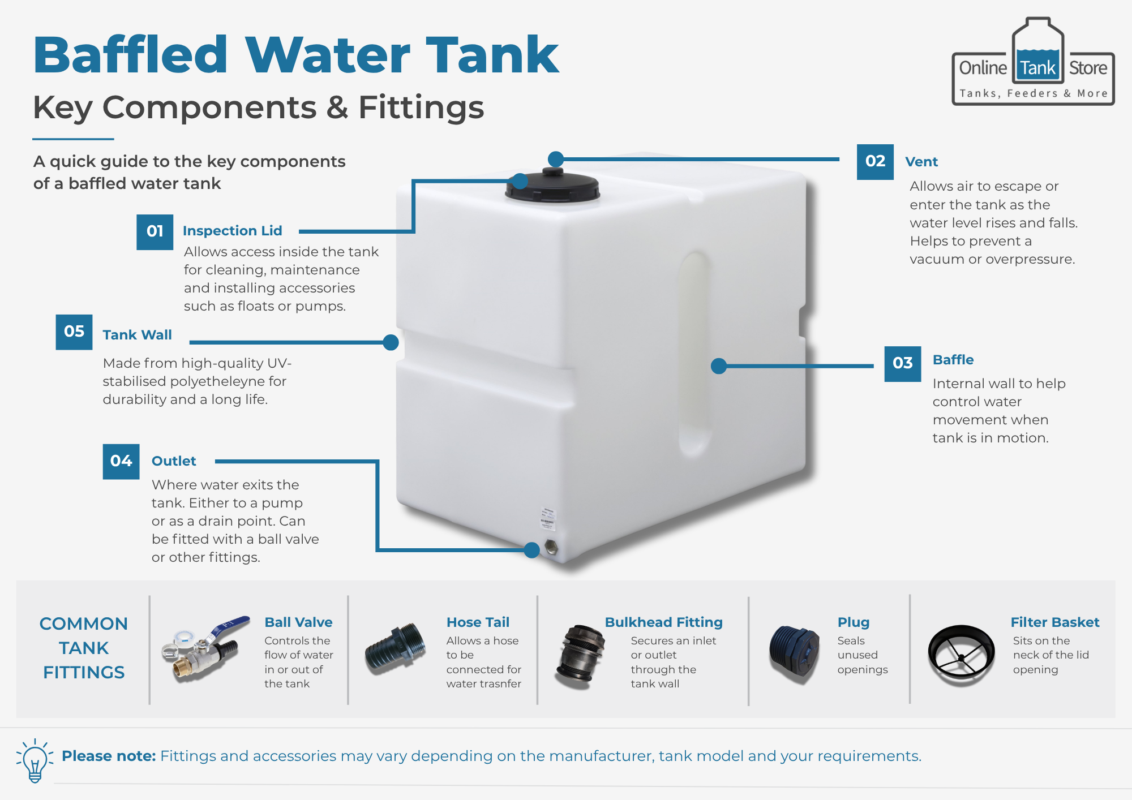
Below you will find a useful infographic explaining the key parts of a baffled water tank. Tanks will vary based on the supplier and method of manufacturer but most will resemble the below in most parts. The key components of a baffled water tank include the inspection lid, vent, baffle, outlet and tank wall.
Baffled Tank Shapes – Upright, Flat and Tower options
Baffled water tanks are available in both upright, flat and tower designs. In most cases, the tanks will have similar dimensions but are in a different orientation. Each option offers advantages depending on the available space, vehicle layout and required capacity.
Choosing between the options will depend largely on where the tank is being installed and how you need to use the space around it.
Upright Baffled Tanks
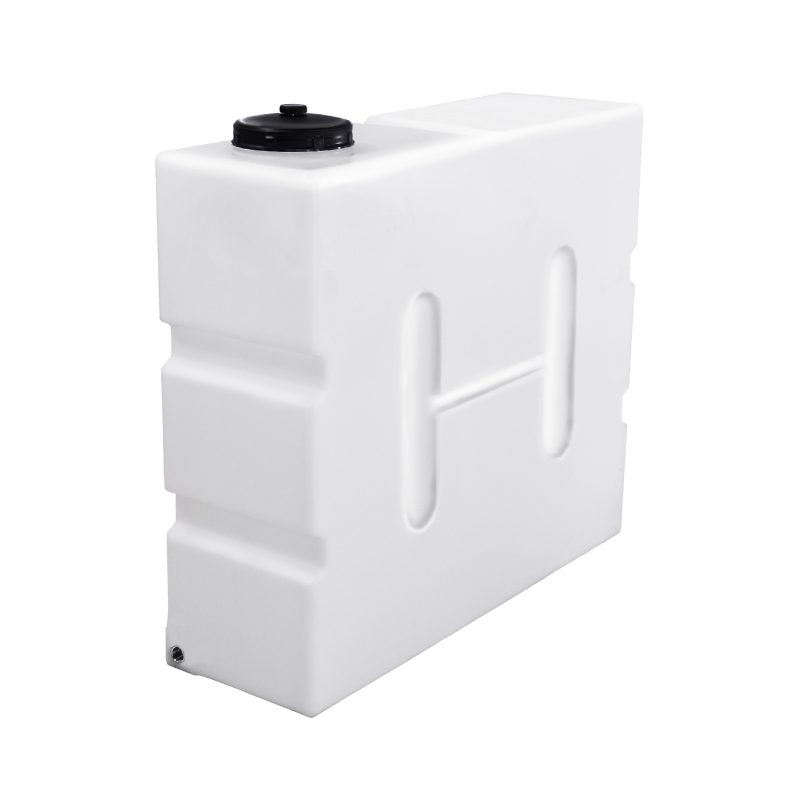
- A good balance between capacity, height and footprint.
- They are vertical in design and are space-efficient based on their narrow design.
Tower Baffled Tanks
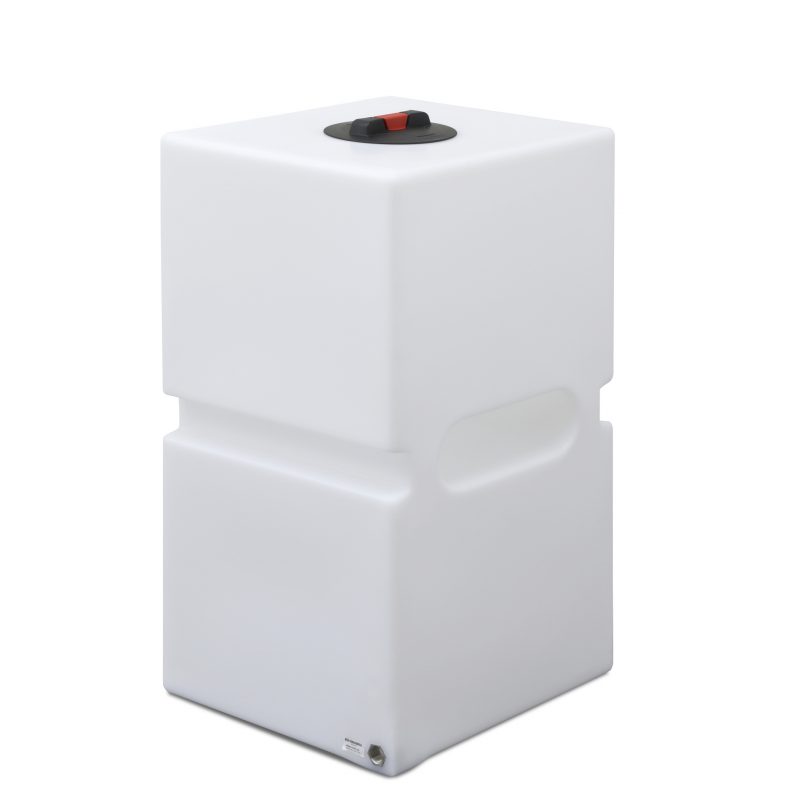
- Also vertical but taller and narrower in order to maximise floor space.
- Compact footprint – greater water capacity whilst leaving the floor space available.
Flat Baffled Tanks

- Lower profile with the weight spread over a larger floor area.
- Useful where height is restricted or equipment needs to be mounted above/around the tank.
Common Baffled Water Tank Fittings
A baffled water tank can be supplied with a wide range of accessories depending on the application;


On this page
Tank weight and payload
It is important to consider the total weight of a baffled water tank when filled. Whilst the baffles help to control the flow of water, the volume of the body of liquid can have a considerable weight.
Water weighs approximately 1kg per litre so the water alone in a 1000 litre baffled tank will weigh around 1,000kg (1 tonne). Alongside this, you also need to account for other equipment, tank fittings and any framing as an example.
If the tank is being transported in a vehicle or trailer, always check the combined weight of the water, tank, equipment and any other mass, to ensure that load stays within the vehicles permitted payload and weight limits.
Full information on securing loads in HGV and goods vehicles can be found here.
Example on a 1000 Litre Baffled Tank when full
Water: ~1,000kg
+ Tank empty weight ~65kg
+ Fittings/equipment, additional weight
= Total loaded weight
💡Always check the manufacturer’s tank weight and your vehicle or trailers permitted payload limits before transporting a full tank in a vehicle.
Choosing the right baffled water tank
Selecting the correct baffled water tank ensures that you get the best performance and value for the task you have. There are a number of things to consider;
- Capacity – how much water do you need or plan to use?
- Dimensions – will the tank fit in the available space?
- Application – transport, static supply, pumped outlet etc.
- Water type – potable (drinking water) or non-potable use.
- Fittings – what inlets/outlets or accessories do you require?
Why Choose A Baffled Water Tank?
The benefits of a baffled water tank.
- Reduces vehicle movement
- Improves transport safety
- Suitable for mobile use
- Various sizes & options
- Configurable fittings
Baffled Water Tank FAQs
What Should I Consider When Buying A Baffled Water Tank?
There are more internal surfaces to a baffled water tank. Therefore, making the tank harder to clean than a standard tank. Consequently, this should be a consideration, especially if the tank is to be used for liquids other than water.
I Plan To Transport The Tank In A Van. What Tank May Be Best?
From experience, our customers favor the Baffled Water Tanks for this application.
A Baffled Water Tank has pre-moulded internal walls called ‘baffles’ which helps to control the movement of the water in the tank during transportation of liquid. This also helps to improve the vehicle maneuverability.
The size of tank required is completely dependent on the size of your vehicle and the set-up you require. The most popular Baffled Water Tanks are as follows: 210 Litre upright, 250 Litre upright, 350 Litre upright and the 400 Litre upright water tank. We do have customers who prefer the larger tanks so this is also an option.
The Baffled Water Tanks are also suitable for use with water-fed poles.
To view our full range of Baffled Water Tanks, click here.
Water Tank Outlet 'Drilled' or 'Undrilled'?
Each tank comes with a outlet as standard. The plastic behind the outlet can be removed (‘drilled’) to allow the liquid to run out of the tank and through a tap if you have one fitted. It can also be left ‘undrilled’ which means it remains closed and the liquid cannot come out through this outlet. You may wish the outlet to be left undrilled if you plan to use the tank purely to store water, as an example.
It is possible to choose ‘drilled’ but purchase a ‘plug’ for the correct size outlet which will seal the outlet when required but allow for flexibility in the use of the outlet. Another option is to choose to have the tank ‘undrilled’ and remove the plastic yourself at a later date.

What Lid Do I need?
Each Water Storage Tank comes with either a ‘Vented’ or a ‘Plain’ lid as standard.
A vented lid allows air to circulate within the tank, helping to control the pressure within it. This is important if you plan to attach a pump to the tank as without this, the pressure may cause the tank may deform. Often, this type of damage is not repairable.
A plain lid is purely for containing the water and stops air getting into the tank.
See below for an example of either type (Note – the lid may look slightly different depending on what tank you are looking at. Please refer to the individual product for details).


In most instances, it is possible to swap a lid for an alternative but please contact us before ordering unless it is offered as an option on the product page.
Do I Need A Tank With Baffles?
We recommend using a baffled water tank to help reduce water movement and improve vehicle stability. Always check your vehicle payload and ensure the tank is safely restrained before transporting. Our baffled water tank range starts from 160 Litres.
What Are The Benefits Of A Baffled Water Tank?
There are a number of benefits to a tank that has internal baffles.
- Reduced water movement
- Improved vehicle handling
- More stable load during transport
- Suitable for mobile applications
- Available in flat, upright and tower configurations
- Wide range of accessories available.
Highly durable medium density polyethylene ensures a robust tank that can up-stand tough conditions. As standard, tanks in the natural colour are manufactured from a WRAS-approved polymer, meaning they are suitable for potable water. This is also semi-translucent, which means the water level can be seen easily.
Can I Add Extra Inlets / Outlets To The Water Tanks?
Yes. This is possible by using a ‘fusion’ and are available in a number of sizes to suit your application or project. View the range here or read our Fusion Socket Guide here for more information. Just add the required fusion onto your order and once complete, we will be in touch to arrange placement of the fusion/s.
What Does 'Potable' mean?
‘Potable’ is a term used to describe a tank suitable for storing water for human consumption. To be classified as potable, the plastic it is manufactured from must conform to the WRAS (Water Regulations Advisory Scheme). For more information on this, please visit the WRAS Approvals website here where they have an information titled ‘What is a WRAS Approval?’.
All our potable tanks adhere to these regulations. It will specify if a tank is potable in the Product Specification section on each product page.